
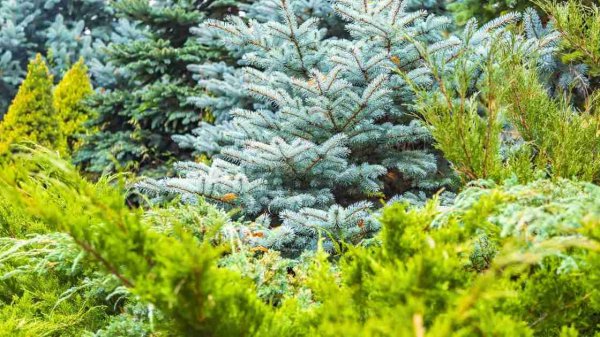
Conifers, a group of woody plants that first appeared in the fossil record more than 300 million years ago, predate flowering plants and now thrive on every continent except Antarctica. With over 600 distinct species—and countless cultivated varieties—these cone-bearing trees and shrubs form an ancient lineage that continues to shape ecosystems and economies worldwide.
Their name derives from Latin: “conus” meaning cone and “ferre” meaning to bear, reflecting their defining reproductive feature. Unlike flowering plants, conifers reproduce through exposed seeds nestled in cones, a trait that classifies them as gymnosperms. Most conifers are also recognized by their needle-like or scaly leaves, though these vary dramatically across species.
Anatomy and Diversity
Conifers exhibit remarkable physical diversity. While many have a characteristic conical shape, others deviate. Needles range from the elongated leaves of pines—such as the short-leaf and longleaf varieties—to the dense tufts of firs or the feathery, blunt clusters of cypress and cedar. Cones themselves vary from round to oblong, with overlapping scales that protect seeds until maturity. Some species, like junipers, produce berry-like female cones with merged scales, while male junipers bear more traditional cones.
Bark also varies: mature conifers often have rough, scaly bark, but species like the eastern red cedar feature soft, peeling bark. Despite being labeled “softwoods,” conifers’ wood is not inherently weak; rather, it has a different internal cell structure than hardwoods. Many conifers produce fragrant, colorful wood and sticky sap.
Reproduction and Wildlife Value
As gymnosperms, conifers reproduce via exposed seeds. Male cones release copious pollen in synchronized bursts, which wind carries to female cones—on the same or different trees. After fertilization, seeds develop within cones and drop at maturity. This ancient reproductive strategy supports diverse wildlife: conifers host specialized insects, serve as larval food for butterflies and moths, and provide foraging grounds for birds. Their seeds feed numerous animals, while the trees themselves offer shade, shelter, and nesting sites.
Economic and Ecological Significance
Conifers are economically vital. Christmas tree farming relies heavily on fir and spruce species. Pine lumber forms the backbone of construction, and conifer wood is used in furniture and small objects. Beyond timber, conifers yield paper products—from printing paper to cardboard—as well as oils, turpentine, soaps, and mulch. Even musical instruments are crafted from conifer wood. In landscaping, junipers, pines, and spruces are garden-center staples, used as accent plants, shade trees, and bonsai.
Ecologically, conifers dominate several biomes. The boreal forests of the northern hemisphere, including the taiga, are primarily pine, larch, and spruce. In the southeastern United States, longleaf pine forests depend on natural fires to reduce competition; their seeds only sprout after a fire. Tropical and subtropical coniferous forests in Central America and Indo-Asia feature various pines. Cypress swamps, both temperate and tropical, are home to water-loving cypress trees. The redwood forests of the Pacific coast boast giant sequoias and coast redwoods that exceed 300 feet in height and can live over 2,000 years. Mixed forests also blend conifers with hardwoods like oak, hickory, maple, and beech.
Common Conifer Groups
Familiar conifer groups include cedars (eastern red cedar, western red cedar), cypress (bald cypress, thuja), redwoods and sequoias, firs (Fraser fir, balsam fir), hemlocks (eastern and western), junipers (creeping juniper, Rocky Mountain juniper), larches (western larch, tamarack), pines (loblolly pine, ponderosa pine), spruces (blue spruce, Norway spruce), and yews (Pacific yew, English yew). Each group has distinct needle and cone characteristics, aiding identification.
Conifers inhabit deserts, rainforests, and everything between. Recognizing them is often as simple as spotting needle-like leaves and cones. For those interested in cultivation, selecting species suited to local conditions ensures success. These long-lived, low-maintenance plants remain a practical and enduring choice for landscapes and ecosystems alike.