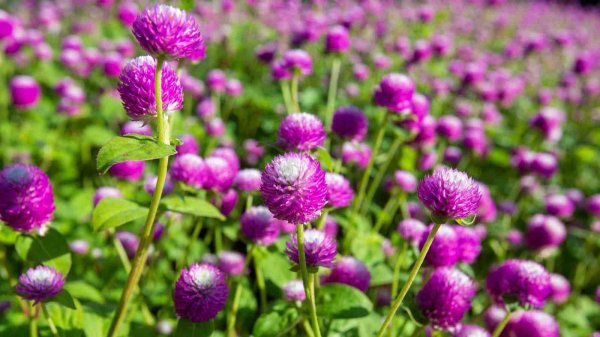
Gardeners seeking a resilient, colorful addition to their beds or containers need look no further than globe amaranth, a genus of flowering plants known botanically as Gomphrena. These plants, which thrive in full sun and tolerate heat and humidity, produce spherical blooms in a spectrum of colors, making them a favorite among both home gardeners and cut-flower enthusiasts. The flowers, composed of papery bracts, retain their color and shape when dried, adding to their appeal for crafts and everlasting bouquets.
Gomphrena belongs to the Amaranthaceae family, but unlike its larger, spiky amaranth relatives, it forms compact, gumdrop-shaped blossoms. The genus includes two primary species: Gomphrena globosa, a lower-growing tropical annual from Central America, and Gomphrena haageana, a taller tender perennial native to North America, hardy in zones 9 through 11. Generally, globosa varieties suit small spaces, while haageana types are better for larger plantings and longer cut stems.
Top Picks for Cut Flowers and Color
Among the most sought-after cultivars is the 'QIS' series, which stands for Quality in Seed. 'QIS Fiery Sunrise Blend' offers a mix of peach, fuchsia, and red blooms on plants reaching 24 to 26 inches tall, particularly well-adapted to southern gardens. 'QIS Carmine' features intense crimson flowers that hold their color after harvest, while 'QIS Orange' matures in 85 to 100 days and produces uniform, one-and-a-half-inch blooms. 'QIS Pink' and 'QIS Lilac' provide softer pastel options, with the latter growing to 24 to 26 inches and benefiting from wider spacing of eight to ten inches.
The 'Audray' series is another popular choice for cut-flower growers. 'Audray White' offers pristine white blooms ideal for bridal bouquets, while 'Audray Pink' and 'Audray Purple-Red' add cool lavender and fuchsia-purple tones. 'Audray Mix' combines several colors, including fuchsia, pastel pink, white, and light purple, on tall stems. These varieties flower later in the season, taking 95 to 110 days to mature, and require a headstart in colder climates.
Compact and Dwarf Varieties for Small Spaces
For gardeners with limited space, the 'Gnome' series provides dwarf growth, with plants reaching only 10 to 12 inches tall. 'Gnome Purple' features violet flowers and dark green foliage, while 'Gnome Mix' offers a blend of whites, purples, and pinks. Similarly, the 'Buddy' series is bred for a mounding habit under one foot tall, ideal for containers and rock gardens, though its short stems make it unsuitable for bouquets. 'Lavender Lady' stays under two feet and thrives in containers, with seeds germinating best in soil temperatures of 70 to 80°F.
Other notable varieties include 'Fireworks', introduced by Ball Horticulture in 2009, which stands out with hot pink flowers accented by neon-yellow stamens on tall stems. 'Strawberry Fields' produces strawberry-red blooms on 16 to 18-inch stems, and 'Raspberry Cream' offers a mix of pink and creamy-white blossoms. 'Aurea', a rare haageana cultivar, displays apricot, gold, and orange button flowers and is highly drought-resistant. 'Las Vegas Mix' provides a rainbow of purple, pink, and white, suitable for meadow gardens when sown with drought-tolerant wildflowers.
Most gomphrena varieties bloom continuously from early summer until frost, with an average time to bloom of 40 to 60 days from seed. They are generally low-maintenance, requiring only well-drained soil and full sunlight. While many are tender perennials, they are commonly grown as annuals, returning year after year only in zones 9 to 11. Some varieties may self-seed, offering spontaneous color in subsequent seasons.
When selecting a variety, consider the intended use. For long-stemmed bouquets and dried arrangements, the QIS and Audray series are excellent choices. For compact ornamental borders and containers, the Gnome and Buddy series offer dwarf habits without sacrificing flower production. With such diversity, globe amaranth proves a versatile and rewarding addition to any garden.