In late winter, a first-time community gardener in Illinois faced a daunting sight: a 20-by-40-foot plot overrun with weeds and tall grass. By the end of May, that same space had produced more than 25 pounds of vegetables, thanks to a no-dig approach that required no tilling and minimal back strain. The gardener, who asked to be identified only as a renter of a year-round plot through a local park district, documented the transformation in a detailed account that offers a practical blueprint for others considering the method.
The no-dig technique, popularized by British gardener Charles Dowding and featured in a collaboration with Epic Gardening's Kevin Espiritu, involves layering cardboard over existing vegetation, then adding compost and mulch to create beds without disturbing the soil. The gardener, a Zone 5b resident with a short growing season, chose this method to avoid the drawbacks of tilling, which can bring weed seeds to the surface and disrupt soil structure.
Planning the Plot
The plot, oriented north-south and sandwiched between other gardens, came with free city water. The renter's design included a two-foot border bed around the perimeter, six main beds running north-south (each three feet wide with 18 to 24 inches between), and a dedicated compost area. Using Google Sheets to map each square foot, the layout allocated 417 square feet to growing beds and 383 square feet to paths, compost, and storage—a crucial step for budgeting materials.
To deter deer and rabbits, the gardener anchored 7-foot T-posts at each corner and ran horticultural netting around the perimeter, which also served as a trellis for climbing plants like peas and Malabar spinach. The previous renter had already installed two feet of chicken wire, providing additional protection against smaller pests.
Materials and Sourcing
The essential components of the no-dig beds were compost for the beds, mulch for paths, and cardboard as a weed barrier. The gardener also found a bow rake, tape measure, cedar fencing for temporary bed sides, and containers for transport helpful. A local landscape recycling center supplied compost and mulch, sold by the 35-gallon or cubic yard.
Sourcing enough cardboard was a challenge, solved by saving personal deliveries, asking friends, raiding a Costco pile, and finally securing a steady supply from a store manager along the route to the plot. The gardener emphasized using brown cardboard without ink to avoid soil contamination.
Building the Beds
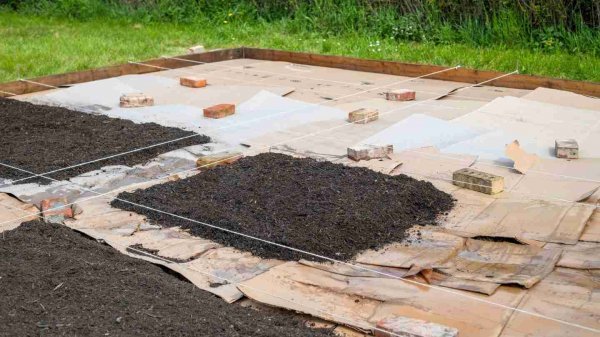
Because the grass was too tall to walk through, the first step was cutting everything down and adding the organic matter to a large compost bin. The bed-building process involved laying overlapping cardboard with no gaps, setting up temporary cedar frames, filling them with 3 to 4 inches of compost, leveling with a rake, and tamping down with a large cardboard sheet to prevent erosion. The frames were then slid along to extend the beds, and mulch was added to paths to reinforce the sides.
Planting began in early March, about six weeks before the average last frost date. The gardener sowed radishes, peas, and greens directly into the beds, covering them with floating row covers to aid germination.
Results and Challenges
By late May, the harvest exceeded 25 pounds, with a high-intensity salad bed producing so much that greens were given away to friends. The gardener also discovered an inherited asparagus patch, a bonus that normally takes years to establish. Unlike container gardening, no perlite or coco coir was added, relying entirely on compost for aeration and drainage.
Weeds did appear, particularly at the edges where cardboard couldn't extend into neighboring plots, and rhizomatic weeds like Canada thistle and mint persisted. However, the weed pressure was significantly lower than in tilled neighboring plots. The gardener plans to focus on edge weeding, cutting flowers before they seed, and heavy straw mulching.
The soil showed clear signs of life, with abundant worms and mycelium in the wood chip paths. The experience underscores that no-dig gardening can be a low-labor, high-yield method for beginners, provided they plan carefully and source materials creatively.