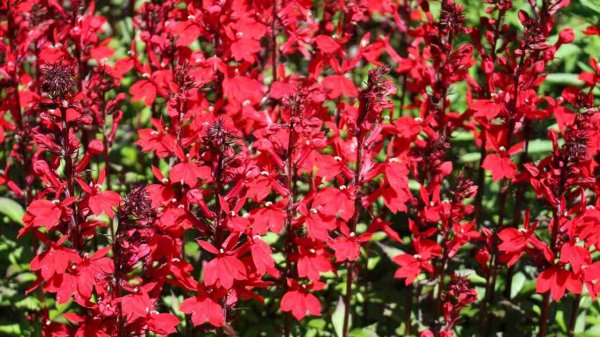
The cardinal flower (Lobelia cardinalis) is a native perennial that brings intense scarlet color to wetland edges and rain gardens across central and eastern North America. Known for its tall spikes of tubular red blooms, this plant is a magnet for hummingbirds and other pollinators. It thrives in consistently moist soil and partial shade, making it a standout choice for gardeners tackling soggy, low-lying areas.
Belonging to the bellflower family (Campanulaceae), the cardinal flower is one of over 2,000 species in this diverse group, which includes bellflowers and balloon flowers. It is native to the central, southern, and eastern United States and Canada, where it naturally grows in wetlands, floodplains, and moist prairies. This herbaceous perennial typically reaches 2 to 4 feet in height, with erect stems lined by shiny, toothed leaves.
In mid-to-late summer, the plant produces its signature scarlet red flowers, which open from the bottom of the spike upward. The blooms last for several weeks before giving way to seed capsules. While the native form is vivid red, cultivars offer pink, white, blue, and purple variations, such as the deep maroon-leaved 'Queen Victoria' and the dark pink 'Starship Deep Rose'.
Cardinal flowers are short-lived perennials that spread by self-seeding and rhizomes, forming attractive colonies over time. They are best planted in rich, moisture-retentive soil with a neutral to slightly acidic pH. While they tolerate full sun in cooler climates, they prefer partial shade, especially in warmer regions, and need 2 to 6 hours of bright light daily.
Propagation and Planting
Gardeners can propagate cardinal flowers by dividing mature clumps in early spring or late fall, which is the quickest method. Starting from seed requires patience: seeds need about two months of cold stratification, either by refrigeration or direct sowing outdoors in fall. Because the seeds are tiny and require light to germinate, they should not be buried. Keep the soil consistently moist until seedlings are established.
When transplanting, choose a cool, overcast day. Prepare the hole with enriched soil, pre-moisten it, and gently place the plant. Water thoroughly after planting and keep the area well-watered for several days to help the roots settle.
Growing Conditions and Maintenance
Cardinal flowers are low-maintenance once established, provided they receive adequate moisture. They are hardy in USDA zones 3 through 9 and perform well in both warm and cool climates with shade and water. Fertilizer is generally unnecessary if the soil is rich; if not, amend with compost at planting time. Mulching in fall helps protect roots from temperature swings and retains soil moisture.
These plants are not drought-tolerant and should be avoided in dry, xeriscaped areas. Instead, they shine along stream banks, pond edges, or in rain gardens where they can be planted with other moisture-loving wildflowers like blue lobelia, southern blue flag iris, and marsh milkweed. Allow at least 12 inches of spacing between plants, as they will fill in quickly.
Cardinal flowers also adapt well to container gardening. Use a rich, moisture-retentive potting mix and place pots in partial shade, checking regularly to ensure the soil remains damp.
Wildlife and Potential Problems
The bright red, tubular flowers are a favorite of hummingbirds, and they also attract butterflies and bees. Deer and rabbits typically avoid these plants, making them a good choice for wildlife-friendly landscapes. The main pests are slugs and snails, which may chew on leaves but rarely cause serious damage. Hand-picking or trapping can manage large populations if needed.
All parts of the cardinal flower are toxic if ingested, so caution is advised around pets and children. With proper care, this native wildflower offers a spectacular late-summer display, turning a moist, shaded corner into a vibrant pollinator haven.